
Relocation of The Oaks visual approach point
Overview
We are seeking feedback on a proposal to relocate the visual approach point (VAP) known as The Oaks (THK) and its accompanying visual flight rules (VFR) route to the west of Camden Airport.
The proposal addresses a risk of aircraft flying close to each other while on different frequencies around Camden Airport and The Oaks aerodrome.
Pilots will typically transit THK when approaching the Camden Airport control zone and contact Camden tower for clearance at 2,500 ft above mean sea level (AMSL) to overfly The Oaks aerodrome circuit. However, the Sydney VTC permits, without recommending, that aircraft could operate as low as 1,900 ft AMSL at THK which is The Oaks circuit altitude. Aircraft flying within The Oaks circuit use a different frequency than those aircraft approaching Camden tower, generating an airspace risk within the area.
A similar risk exists when pilots conduct a mid-field crosswind circuit entry from the west into The Oaks aerodrome. Aircraft could be approaching between 1,900 ft and 2,400 ft AMSL, creating potential conflict with aircraft inbound to Camden Airport via THK, particularly as they are likely to be operating on different frequencies.
The proposed change seeks to address this risk by redirecting aircraft approaching Camden Airport away from aircraft operating at The Oaks aerodrome. It is required to support the broader airspace changes in the Sydney Basin prior to the opening of Western Sydney International Airport.
The proposal
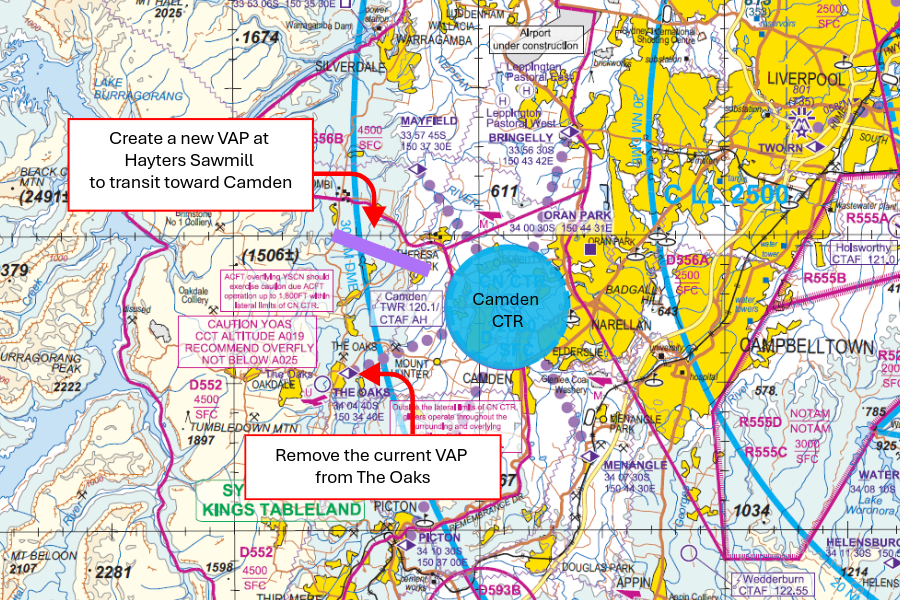
The image above shows the current position of The Oaks visual approach point on the Sydney visual terminal chart (VTC) and the proposed relocation over Hayters Sawmill (thick purple line).
Why your views matter
This consultation provides a platform for airspace users to provide feedback to increase safety and efficiency.
Completing the survey
Please submit your comments using the survey link on this page.
If you would like to provide further feedback, please email OAR@casa.gov.au. Feedback submitted by email will be considered but cannot be published.
Further information about airspace regulation and the airspace change process is available on the CASA website.
What happens next
Once the consultation has closed, we will:
- review all comments received
- make responses publicly available on the consultation hub (unless you request that your submission remain confidential)
- publish a summary of the feedback received and outline next steps.
Information about how we consult and how to make a confidential submission is available on the CASA website. To be notified of any future consultations, you can subscribe to our consultation and rulemaking mailing list.
Audiences
- Aerial work operator
- Aerial work operator (Part 138)
- Aerodrome operator
- Aerodrome owner/operators
- Air operators
- Air traffic control
- Air traffic controller(s)
- Air traffic service provider
- Aircraft operators
- Aircraft owner/operator
- Approved self-administering aviation organisations
- CASA Staff
- Certified aerodrome owner/operator
- Flight instructors and flight examiners
- Flight training operators
- Light Sport Aircraft, Lightweight Aeroplanes and Ultralight Aeroplanes owners and pilots
- Light Sport Aircraft, Lightweight Aeroplanes and Ultralight Aeroplanes sport aviation operators
- Parachute operators
- Parachuting sport aviation bodies
- Part 141 of CASR operator
- Part 142 of CASR operator
- Part 143 of CASR Air Traffic Service training providers
- Part 173 of CASR Certified/Authorised Instrument Flight Procedure Designer Aerodrome
- Part 175 of CASR Aeronautical information service providers
- Pilots
- Pilots of parachuting aircraft
- Sport and recreation operators/clubs
- Sport and recreational pilots
- Sport aviation bodies & prospective ASAOs
- Sports aviation operator
- Training organisation representative
- Unregulated aerodrome owner/operator
Interests
- Aerodrome operators
- Aerodromes
- Airspace and infrastructure
- Flight training
- Registered operators- Private and aerial work operations
- Safety promotion
- Self administration aviation activities
- Sport and recreational aviation
Share
Share on Twitter Share on Facebook