
Proposed updates to the Sydney VTC near Camden and The Oaks
Feedback updated 29 Sep 2026
We asked
We sought feedback on a proposal to update information for The Oaks aerodrome on the Sydney visual terminal chart (VTC), along with associated changes near Camden Airport. The proposal included:
- increase the published overfly height shown in the information box for The Oaks from 2,500 ft to 3,000 ft
- replace the existing visual approach point (VAP) known as The Oaks (THK) with a new visual reference point identified as the 'Chicken Sheds', located in Orangeville, approximately 3 nautical miles northwest of The Oaks.
The changes aim to reduce the likelihood of aircraft operating close to each other while on different frequencies in the vicinity of the 2 airports. It also seeks to address this risk by redirecting aircraft approaching Camden Airport away from aircraft operating at The Oaks aerodrome.
It follows consultation earlier in 2026 on moving the existing VAP to an area over Hayters Sawmill.
The consultation period ran between 6 August and 3 September 2026.
We sought feedback to understand industry issues, observations or positions on:
- safety or operational considerations associated with the proposed location that could impact the use or management of airspace in and around Camden and The Oaks
- any other feedback about the visual approach point, visual flight rules (VFR) route or overfly height changes.
Local airspace users including flying schools, aero clubs, commercial operators, recreational and sport aviation as well as industry bodies were encouraged to respond.
You said
We received 51 responses through the CASA Consultation Hub, with a small number also received via direct email.
Submissions were received from a wide variety of airspace stakeholders. Most responses received were from recreational and private pilots. We also received responses from training organisations, commercial and instrument flight rules (IFR) pilots, safety managers and chief pilots.
Summary of feedback
Respondents recognised the changes could enhance safety by reducing the airspace risks near The Oaks. However, further analysis reveals additional information.
Safety or operational considerations
Feedback about the safety and operational considerations associated with the proposed location of the VAP varied among the respondents.
Submissions from the recreational and student pilot cohort almost unanimously agreed that relocating the Camden VFR approach point further north is an effective means of reducing the likelihood of Camden bound aircraft flying directly through The Oaks circuit, citing that the proposed 'Chicken Sheds' VAP provides a large, distinctive and readily identifiable visual reference.
The provision of information from air traffic services and ensuring clarity and consistency of information within the Aeronautical Information Package (AIP) were common recommended additional measures among all groups.
However, some respondents from training organisations as well as commercial and IFR pilots were cautious about the proposed location. They recommended the introduction of procedural departures from Camden and establishing segregation of the inbound and outbound routes to and from Camden rather than relocating the VAP.
Respondents also raised concerns that the relocation will drive traffic toward already congested airspace, while removing the VAP altogether was also suggested. Some IFR operators commented that The Oaks is a more geographically prominent feature and operators are likely to navigate to the aircraft landing area by choice or misidentification regardless of the relocation of THK.
Feedback indicated that operating on separate frequencies, as well as information published in the VTC and AIP, is the primary cause of the current airspace risk. Some respondents felt the proposed changes do not fully address those considerations.
Visual approach point, VFR route or overfly height changes
Feedback about the VFR route and overfly height changes differed based on the group of respondents.
Recreational and student pilot responses were supportive of increasing the published recommended overfly height for The Oaks on the VTC. Comments suggested it would provide increased vertical separation, reduce congestion, improve the safety margin and have a positive effect on the workload of pilots operating in The Oaks circuit.
Commercial and IFR responses held reservations about the overfly height change. While the change is likely to provide an additional layer of safety, respondents cited a perceived lack of airmanship as the primary cause of the current situation and the proposed changes do not address this issue. Clear and consistent information within AIP and electronic flight plan platforms, as well as pilot education, is considered equally important.
Feedback also raised broader operational concerns about:
- the proximity of the proposed VAP to the Western Sydney controlled airspace steps
- the potential for outbound traffic to be funnelled toward The Oaks to avoid the proposed VAP
- the possibility that the proposed 3,000 ft overfly height could push aircraft into non-VMC conditions.
Respondents also identified potential impacts for IFR operations:
- IFR traffic transiting to Bankstown on the instrument flight route may encounter VFR traffic at the same altitude, likely to be on different frequencies and with different performance characteristics and equipage requirements.
- The instrument approach into Camden is likely to be affected by the recommended altitude increase.
- Operators seeking to depart Camden to the northwest and remain outside of controlled airspace would typically navigate above the current recommended altitude of 2,500 ft. Increasing the height to 3,000 ft may drive departing aircraft further to the west, increasing the risk of airspace incursions and operating toward higher terrain.
Other comments
The following suggestions also featured:
- Making the equipage of radios and conspicuity devices mandatory.
- Mandating, rather than recommending, the overfly height.
- Camden Airport controllers to provide information in clearances to departing aircraft travelling in the direction of The Oaks Airport.
- Urging pilots to make 10 nautical mile broadcasts when approaching The Oaks airspace to announce their intentions and alert other traffic to their presence.
- Consider the impact of the gliding operations in the vicinity of Camden and The Oaks.
- Consider establishing a danger area around The Oaks as a means of highlighting the potential collision risk.
- Publish information in the Camden ERSA FAC page regarding operations in the vicinity of The Oaks.
- Re-establish the Bankstown non-directional beacon and associated procedure.
- Reconsider the removal of Menangle as a Camden VAP as well as introducing a north easterly VAP at either Leppington or Hoxton Park.
For more detail, view the published responses below.
We did
Next steps
CASA appreciates the contributions made by respondents and acknowledges that their feedback has been beneficial to the consultation process.
It is clear from the responses that relocating the VAP is considered by many to be a safety enhancement, however the proposed location of the replacement VAP should be considered carefully including a full risk assessment to support the next phase.
The proposed changes to the overfly height recommendations are largely considered an enhancement to safety however the impact on IFR operations needs to be carefully considered and assessed prior to proceeding.
We are now considering and reviewing the feedback received, as well as safety information about the area, to determine how to proceed with any airspace changes and what these might look like. This will involve follow up information to all stakeholders in the coming weeks.
Published responses
View submitted responses where consent has been given to publish the response.
Overview
We are seeking feedback on a proposal to update information for The Oaks aerodrome on the Sydney visual terminal chart (VTC), along with associated changes near Camden Airport.
The changes aim to reduce the likelihood of aircraft operating close to each other while on different frequencies in the vicinity of the 2 airports.
It follows consultation earlier this year on moving the existing visual approach point (VAP) to an area over Hayters Sawmill. Through our consultation we received feedback that the proposed location was unsuitable due to its proximity to the Western Sydney International Airport control zone boundary. This feedback has been considered with the development of this new proposal.
Published overfly height for The Oaks aerodrome
We are seeking feedback on increasing the published overfly height shown in the information box for The Oaks from 2,500 ft to 3,000 ft. The proposed change is intended to further increase vertical separation between aircraft transiting the area and aircraft operating in The Oaks circuit, reducing the likelihood of conflicting traffic operating on different frequencies.
The information box on the VTC would be updated to the following:
| 'CAUTION YOAS CCT ALTITUDE A019 OVERFLY NOT BELOW A030' |
Camden Airport visual approach point and VFR route
We are also proposing to replace the existing VAP known as The Oaks (THK) and associated visual flight rules (VFR) route with a new VAP and VFR route further north.
Earlier this year we sought feedback on moving the VAP to an area over Hayters Sawmill. Through our consultation we received feedback that the proposed location was unsuitable due to its proximity to the Western Sydney International Airport control zone boundary.
We are proposing a new visual reference point identified as the 'Chicken Sheds', located in Orangeville, approximately 3 nautical miles northwest of The Oaks. The 'Chicken Sheds' are 4 large, white-roofed sheds arranged in a distinctive herringbone pattern, making it easy to identify from the air.
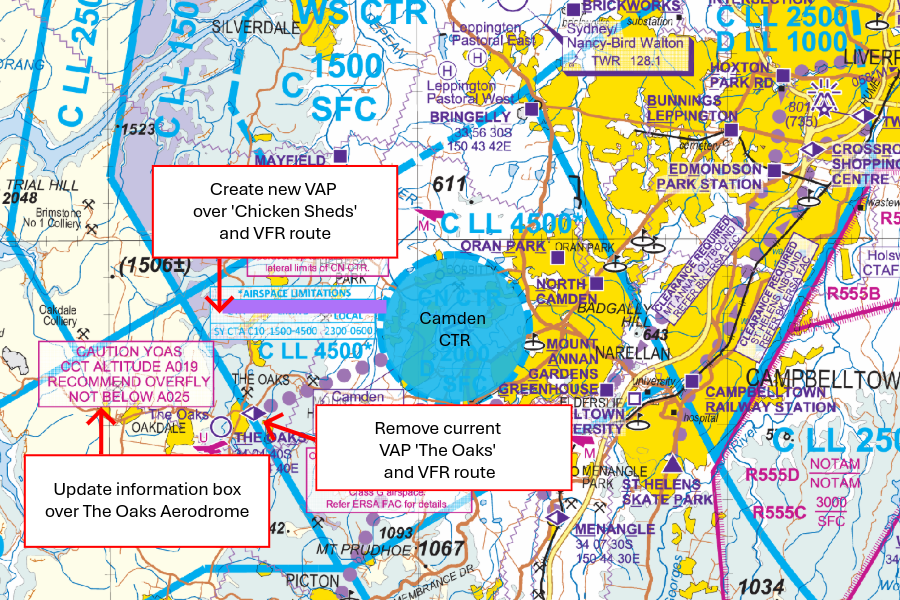
Above image (9 July Sydney VTC, edited): Shows the proposed new location of a VAP and VFR route into Camden Airport (thick purple line) and highlights the information box that will be updated.
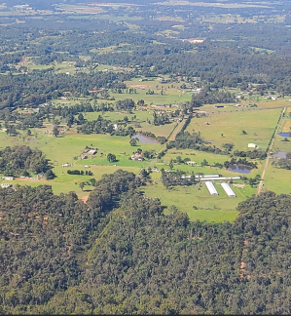
Above image: An aerial view of the 'Chicken Sheds' in Orangeville.
Background
When overflying The Oaks aerodrome circuit, pilots will typically:
- transit THK when approaching the Camden Airport control
- contact Camden tower for clearance at 2,500 ft above mean sea level (AMSL).
While the Sydney VTC recommends that aircraft operate no lower than 2,500 ft AMSL, aircraft may operate as low as 1,900 ft AMSL at THK which is The Oaks circuit altitude. Aircraft flying within The Oaks circuit use a different frequency than those aircraft approaching Camden tower, generating an airspace risk within the area.
A similar risk exists when pilots conduct a mid-field crosswind circuit entry from the west into The Oaks aerodrome. Aircraft could be approaching between 1,900 ft and 2,400 ft AMSL, creating potential conflict with aircraft inbound to Camden Airport via THK, particularly as they are likely to be operating on different frequencies.
The proposed changes seek to address this risk by redirecting aircraft approaching Camden Airport away from aircraft operating at The Oaks aerodrome.
Why your views matter
This consultation provides a platform for airspace users to provide feedback to increase safety and efficiency.
Completing the survey
Please submit your comments using the survey link on this page.
If you would like to provide further feedback, please email OAR@casa.gov.au. Feedback submitted by email will be considered but cannot be published publicly.
Further information about airspace regulation and the airspace change process is available on the CASA website.
What happens next
Once the consultation has closed, we will:
- review all comments received
- make responses publicly available on the consultation hub (unless you request that your submission remain confidential)
- publish a summary of the feedback received and outline next steps.
Information about how we consult and how to make a confidential submission is available on the CASA website. To be notified of any future consultations, you can subscribe to our consultation and rulemaking mailing list.
Audiences
- Aerial work operator
- Aerial work operator (Part 138)
- Aerodrome operator
- Aerodrome owner/operator
- Air operators
- Air traffic control
- Air traffic controller(s)
- Air traffic service provider
- Aircraft operator
- Aircraft owner/operator
- Amateur/kit-built aircraft owners and builders
- CASA Staff
- Certified aerodrome owner/operator
- Flight instructors and flight examiners
- Flight training operator
- Flight training operator - helicopters
- Gliding clubs
- Helicopter pilot
- Instructors and flight examiners
- Light Sport Aircraft, Lightweight Aeroplanes and Ultralight Aeroplanes owners and pilots
- Light Sport Aircraft, Lightweight Aeroplanes and Ultralight Aeroplanes sport aviation operators
- Parachute operator
- Parachuting sport aviation bodies
- Part 141 of CASR operator
- Part 142 of CASR operator
- Part 143 of CASR Air Traffic Service training provider
- Part 173 of CASR Certified/Authorised Instrument Flight Procedure Designer Aerodrome
- Part 175 of CASR Aeronautical information service provider
- Pilots
- Pilots of parachuting aircraft
- Self-administering aviation organisation
- Sport and recreation operators/clubs
- Sport and recreational pilot
- Sport aviation bodies & prospective ASAOs
- Sports aviation operator
- Training organisation representative
- Unregulated aerodrome owner/operator
Interests
- Aerodrome operators
- Aerodromes
- Airspace and infrastructure
- Amateur/kit-built aircraft
- Flight training
- Private operations
- Registered operators- Private and aerial work operations
- Safety promotion
- Self administration aviation activities
- Sport and recreational aviation
Share
Share on Twitter Share on Facebook